Breaking the rules

Social codes are funny things. Unwritten as they are, one can never be entirely sure who’s in the right of it if there is a disagreement over what is acceptable and what is not. Or rather, the departure from the “agreed behaviour” has to be rather glaringly obvious before one can define it as a breaking of rules.

Since I’ve recently started a new job which entails travelling a little further every day to get to the office I have started getting an earlier bus in the morning and have suddenly aquired  all new travelling companions. Significantly fewer travelling companions, too, whereas the later bus tends to be standing room only shortly after I get on (I normally got a seat, but by the next stop or two all the seats would be taken), I now frequently get a double seat all to myself. This makes any odd behaviour all the more noticeable, obviously.

My most faithful companion on this new service is a lady in, uhm, her fifties I think. I noticed her immediately, as she was the only one waiting at the stop when I arrived on the first morning of my new schedule. When the bus arrived we were still the only ones there, and I moved from the bus shelter to the side of the road to signal to the bus that, yes, indeed, I did want it to stop and pick me up. My companion, however, stayed in the shelter until the bus had actually stopped. It was not raining or anything and the shelter is quite far from the roadside, but there is only one bus service that passes this stop, so the drivers tend to assume anyone standing at the stop wants to get on whether they signal or not. I put it down to “slightly odd but not unusual” and got on with the getting on the bus and finding a seat and all that.

Some mornings later I’d noted that this was her normal behaviour, and though I found myself wondering if she would alter it were she alone at the stop I had filed it away as “not very interesting”*.  Then, one morning, I found a window seat, as usual in an almost empty bus, and seconds later this woman sat down next to me.

Uhm. Ok, lady, I don’t know you, the bus is almost empty and you actually chose to follow me onto the bus and sit down next to me?

For your eddification, here is a summary of the accepted rules hereabouts for where to sit down when you get on the bus, as far as I understand them:
1. If the bus is empty, have a ball, sit wherever you like.
2. If you’re number two, get a seat reasonably far from number one.
3. If you’re number 3 upwards, get a seat in one of the free double seats (or, obviously, one of the single seats if the bus has them), making sure the passengers are spread nicely throughout the bus. Exceptions to the spreading principle are old people/people with crutches etc. who are allowed to take any seat they find convenient, even to sit beside someone else before all the doubles have people seated in them.
4. Once all the double seats in the front of the bus and most of the ones in the back have people in them, you may sit down next to someone else. If you get to the back and discover a free double, you should choose that, however.
5. Never ever sit down next to the person who got on the bus just in front of you.

Unfortunately (well, for me, since I’m terrible at smalltalk), you ARE supposed to sit down next to any acquaintances, even if the bus is mostly empty.

Back to the morning in question:

While my mind is screaming “Psycho!” I gave her the benefit of the doubt and ignored her. She in turn ignored me, so that was all very well. Still, I tried to work out what had caused this complete breach of accepted behaviour and concluded I’d somehow sat in “her” seat.

The following morning I chose a seat a bit further back and watched her sit down in the window seat I’d been in the day before. My assumption that this was “her” seat was thereby confirmed. This morning the bus was practically empty, but someone was already sitting in the window seat of the double preferred by our friend. Our friend sat down next to her.

I don’t know where I’m going with this, you know. Well, I suppose it doesn’t matter. Interestingly, due to this woman’s consistency in her choice of seat she has effectively stopped me from choosing that particular one in the mornings as surely as if she’d got on the bus in front of me and sat down first. In other words, once you obey the rules they even work backwards, so to say.

____________
* What is defined as interesting in normal terms and what may seem interesting early in the morning when you’re sitting on the bus and have nothing better to do are, of course, quite different things. That said, I find it rather fascinating to watch other people’s behaviour, even at the best of times, so even trivial oddities may catch my attention.  

(Un)smugness

I’ve been feeling alternately smug and despondent lately.

The smugness mainly came from watching my neighbours throw away perfectly usable items in the two big skips (two? we made do with one last year) that are always brought in this time of year. Had we had a little more storage space I would probably have scrounged some of it, but we don’t. Besides, most of it was “deconstructed” in order to make stacking more efficient, we watched, somewhat gobsmacked, as two grown men smashed a set of six pine dining room chairs which looked, though a little out of fashion, perfectly serviceable. I disposed of exactly two items myself. One (short) length of decking which became surplus when my father built a new set of steps for our veranda – as you’re not supposed to burn these due to unsafe emissions it had to be thrown out. The other was our old barbeque, whcih we paid all of 99 NOK for in 2005 and which has languished outside in the snow over the past three winters. The ventilation valve thing was actually not quite right to start with, that’s what you get for being a cheapskate, and it had now rusted into position which meant that when hubby tried to barbeque some sausages a few weekends ago it wouldn’t heat up sufficiently. I declared it dead and threw it out. I am now insisting we buy an “expensive one”, one that costs, oh, at least 300 NOK, and get/make a cover for it in order to protect it from the weather, at least over the winter. Where was I? Oh, yes, the smugness, then, originated in wathcing my neighbours throw away Good Stuff whereas we instead put an ad up at finn.no in the “free” section and were pleased to have people arrive and carry away our “junk” with big smiles on their faces. Very eco-friendly and bringing joy to mankind (well, a couple of people, anyway) into the bargain.

The desponancy came from realising this is a drop in the ocean and that we really need to do so much more, as well as persuading our neighbours to follow suit. I was checking the Times website for mayoral and other news the other day and found their list of “top 50 green blogs“, and things followed on from there and I read lots of sites on carbon neutrality and people installing solar panels and growing their own food. Which made me feel I was a long way off. Then I started reading Naomi Klein’s The Shock Doctrine and that really got me down. Seriously? This head-in-the-sand strategy is looking quite good at the moment.

Well, every little helps. I have to go to Oslo for a course in mid-June, which was convenient, because I was planning to go to Oslo for the weekend following the course anyway (Alanis Morisette at Norwegian Wood, that’s why, also time to see Oslo and, more especially, T and L again)  and now my employer is paying for the tickets which can’t be a Bad Thing. So I decided to take the train instead of going by airplane. I might have considered doing so in any case, but now I get the night train down Monday night with a sleeper compartment which means I can be bright and awake for the start of the course on Turesday. And I get the night train back on Sunday evening after the festival has ended and arrive bright and early in Trondheim just in time to go to work on Monday morning. The tickets, including sleeper, are twice what you’d normally manage to get plane tickets for this far in advance. And they’re all paid for by someone else. Nice.

Not so nice: Spending a week away from the lass – and the husband. A week is a long time. This week, for example, she learned to say “katt” (cat) and I finally realised her “kaddæ?” is probably Trøndersk (the local dialect, not mine, the husband’s though, as well as all her playmates’)  and means “Ka e det?” (what is that?) – at least most of the time. If I go away for a week I’ll probably come back and find she’s learnt to recite Shakespeare. Or Kaptein Sabeltann. Oh, the horror.

A four-letter word

It’s a meme! A love list:

I love being a mother. I love my daughter and the way she can make my heart lift by simply looking at me while pointing her hand in the general direction of whatever it is she wants and saying “de?” I love the way her hair stands up in all directions and the smell of her neck when she snuggles close. I love her sticky little hands and her perfect ears and toes and fingers and all. I love the way she’s discovered communication and how her vocabulary is increasing steadily. I love how she falls asleep in my lap and forces me to stay stationary for however long it takes because I don’t have the heart to wake her up. I love how she hardly ever says ma-ma or ba-ba, even though she is perfectly able to, because we’re always right there so there’s no need to call us. I love that she is independent enough to accept being left with her minder or with her grandparents without complaining. I love the way she is delighted to see me when I return and drops whatever she is doing to come and give me a hug. I love how she’s turned my world upside down in more ways than I thought possible. I love the way I love her so much I think my heart might burst whenever I hear her laugh and that it breaks a little every time she cries.

I love rain and wind. I love going for walks along the seaside when you can hardly stand up straight because it’s blowing so hard. I love going out in the rain in the summer and getting soaked through to the skin. I love coming back from a wet and windy walk and snuggling up with a blanket and a warm drink. I love thunder and lightening. I love watching a thunderstorm roll in towards where I’m standing, the flashes and crashes getting closer, the closer the storm gets.

I love my husband. I love the way he makes me laugh. I love the way he makes my heart melt when he smiles. I love the fact that he can’t be bothered to get a haircut until his hair is way too long and gets in his eyes and how he then gets it cut so short he looks like a little kid whose mom has instructed the barber to give him “a cut that will last the summer”. I love the way he interacts with our daughter, and the way his love shows on his face and in his body language when he’s with her. I love the way he buys me tulips at odd times just because I love them. I love the way he cooks bacon and I love his homemade pizza. I love the way he loves me.

I love my parents. I love my father’s hugs. I love the way my mother and I will laugh until we cry for the smallest thing. I love that I am able to consider my parents as friends.

I love music. I love putting on my favourite songs at full volume and singing along.

I love dancing. I love it when everything comes together in a set of Scottish country dancing and people fly through the room in a perfectly coordinated pattern. I love dancing strip the willow with my husband and spinning so fast we can hardly stand when we’re done.

I love photography. I love seeing the world from new angles. I love attempting to catch the moment. I love my Canon EOS 300D and I love that I can see the result of my experiments immediately. I love being able to manipulate the image in Photoshop, or to leave it be just the way it is, perfect in its imperfection.I love computers. I love getting dug into a piece of code and having it finally, magically come together and work. I love the internet and its possibilities.

I love my friends. I love how we can hardly talk for ages – years – and then still pick up just where we left it when we meet again. I love that they accept it if I say I have to call them back because I’m in the middle of a book I can’t put down.

I love Scotland. I love the people, the landscape, the literature, the music, the dancing, the accent, the pubs, the whisky and even the weather.

I love single malt whisky. I love the way every single bottling tastes different from the last. I love the skill and craft that goes into making a good malt. I love the touch of magic that the wood brings, making each cask a surprise, even to the most knowledgeable of experts. I love the myths and stories that are perpetuated by the people in the business and I love that no one really knows which ones are at least partly true and which ones are pure fiction. I love the smells of a distillery, the shock of malted barley flour in the mill room, the breakfasty smell of the mash, the CO2-infested beery smell of the wash, the warm, heady, sulfury smell of the new spirit as it runs off the still and the damp, mouldy smell of the warehouse – shhh, whisky sleeping. I love the people who work in the business, how they – almost without exception – really love what they do. I love their fierce loyalty to “their” distillery and how they grudgingly admit to some other malts being “rather nice”. I love the enthusiasm of whisky lovers and the nitpicking, extremely detailed and downright nerdy discussions we get into.

I love the sea. I love walking along a beach on a sunny day and I love the way the waves crash on the rocks in a storm. I love the soft breeze carrying wafts of saltiness and seaweed and I love the heady spray of troubled waters.

Ignorance is bliss

Or so they say. All I know is willful ignorance in others makes me annoyed and peevish. As when we travelled by plane over easter and the baby (I really should stop calling her the baby, she isn’t anymore, she’s grown into a little lady with a mind of her own, but as I don’t want to use her name on the internet much, I need a new nickname, I know:) the little lass got a “kid’s package” from the hostesses at SAS.

This consisted of a box vaguely decorated to resemble a plane, oval windows down the sides and a plane front window at one end where you could see the pilots and so on, populated by lions. On the box lid the text reads: “Løvemat. Nesten det samme som løvene spiser.” (Lion food. Almost the same as what lions eat.)

The contents: One tiny carton of orange juice, one bag of fruit jellies shaped like small airplanes, one set of colouring pencils and one colouring book – the latter also populated by lions.

The question: Which of these items supposedly resembles something a lion would eat?

Why couldn’t they have called the concept “Monkey food” instead and populated the plane with monkeys? That would at least have been half-way plausible.

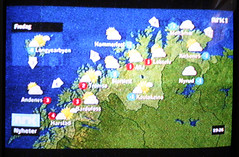
I know, I know. Hardly a big thing in the great scheme of things. It’s just that it’s so unnecessary. And it kind of falls into the same category as a lot of the spelling mistakes that make me cringe. People, when this sort of mistake is pointed out, say “But it’s not important. Everyone understands what we are trying to say.” I beg to differ. Some people might actually not understand. And it IS important. I’m probably going to be one of those mothers who write to the television companies and point out the basic mistakes they make in children’s programmes. I nearly did the other day, in fact. There was a song about an explorer where they had illustrated one of the poles with pictures of both polar bears and penguins – which probably explains why I can’t remember which pole they were singing about. In the case of the SAS lions, I doubt whether any of the design team actually believe that lions eat fruit jellies shaped like little airplanes. When it comes to the polar fauna, I’m not so sure the misinformation is willful. After all, a recent survey shows that 13 percent of adult Norwegians believe there are polar bears in the region known as “Nord-Norge” – Northern Norway. In case you’re wondering, no, there are no polar bears in Nord-Norge. At Svalbard, yes, but that is another matter entirely. Mind you, since we’ve all grown up with the “for illustration only” weather map of Norway – with Svalbard floating off the west coast of northern Norway – perhaps most people believe it’s just a skip and a jump across the North Sea from the mainland to our northerly neighbour. It ain’t.

Anyway, why do I think all this is important? Well, apart from being pedantic and just instinctively disliking willful ignorance to the point of agressiveness (seriously, around me it pays to at least pretend to be interested in factual accuracy), I honestly believe this is a symptom of what got the human race into trouble in the first place. If it’s not particularly important to know what a lion eats, it follows that you’re not really interested in how the lion fits into the ecosystem and if you don’t know that, then you won’t be able to see any reason why we need lions in the first place, hence it doesn’t really matter if they become extinct. And if lions don’t really matter to you – they live in Africa, after all (oh, and a very small population in India, remnant of the subspecies Panthera leo persica which once covered most of Asia – did you know that?), and Africa is a far way off (though not quite so far if you run an airline, I should have thought, but never mind), then I suppose you don’t really mind if the whole continent of Africa becomes deforrestated, either? I mean, it won’t affect you, will it?

And so on. Not incidentally, I’ve been overdosing on Gerald Durrell lately, but I read Durrell because I believe in much of the same principles he believed in, not the other way around.

To add insult to injury, the lions were butt ugly, imho.

Oh, and the colouring pencils? Worst ever. Pressing down hard I could barely make a mark in the colouring book, the lass, having grasped the main idea of writing implements but not having had much time to practice and lacking in precision and force stood no chance at all.

Composition challenge

Joining the gameChallenge 8 – Folk Lore

My parents have a fairly large set of friends that they’ve kept in touch with since their student days, some even longer, so many, in fact, that even now I have problems remembering who they all are. This impresses me wildly. I’m lucky if I manage to keep in touch with anyone except a chosen few for more than a month after I stop seeing them daily – I’ve forgotten the names of most of the people I worked with a year and a half ago – and I’m of the internet persuasion and have all these social networking tools at my fingertips. It obviously doesn’t help.
Anyway, back to topic: Two of these friends, husband and wife, are both doctors and live on a farm somewhere in Nord-Trøndelag (I forget the details). Quite an impressive place, apparently, but definitely rural. My brother and I are both city/town bred, hardly “big city” in the international sense, but still, urban enough.

When I was 4 or so we went to visit this family. Apparently, the first utterance from my four-year-old self upon embarking from the car was “Where is the playground?”

Twelve years or so later, my brother accompanied my parents on a visit, he would have been nine or thereabouts. The lady of the house gave him a glass of milk from the cows of the farm out of the fridge. His answer, when asked how he liked it, was “Well, it’s kind of strange to think that it comes from the cow.”

My parents would have been mortified if they hadn’t been too busy laughing. What sort of city slickers had they brought into the world?

(In my brother’s defence, he knew better, of course, it just came out the wrong way. I was probably genuinely interested in knowing where the playground was.)

Having written that, I’m no longer sure it counts as family folk lore (though it’s told often enough in my family, I assure you), but at least it’s a good story.

I might try to catch up on some of the earlier challenges, too. The net knows I could use some new content on this so called blog.

Of apostrophes and other animals

Meg wrote a fantastic entry recently entitled Malapostrophication, crap marketing agencies, and why its they’re fault you’re business look’s dumb. Just in case you don’t go through my blogroll every day, you know.

I must remember to get my camera out more often when I see signs like that. I don’t seem to have any malapostrophication examples uploaded to Flickr, so you’ll have to make do with the one on the right as an illustration for now.

Posten: En liten historie fra virkeligheten

En av oppgavene mine i nåværende jobb (som jeg slutter i på fredag, juhuuu) er å hente posten – fra tre postbokser og til fem firmaer samt et par stiftelser osv. Dette fører selvsagt til at post som faktisk skal til oss er adressert til veldig mye rart, særlig siden noen av enhetene har litt lange navn og/eller har skiftet navn (noen for over 20 år siden, men det tar tid å rette adresselister, må vite).

Postboksene har nummer 23, 758 og 1580* – og det er særlig den midterste, som tilhører hovedarbeidsgiveren min, som tiltrekker seg mye irrelevantheter. Noe av grunnen er at arbeidsgiver eier bygget vi sitter i og leier ut til diverse fimaer (blandt annet de andre vi henter posten for) og alt som er adressert til denne gateadressen og som posten ikke klarer å plassere havner derfor hos oss. Greit nok, på sett og vis.

Mandag denne uken fikk vi et brev i postboks 758 som var adressert til Fiktivia AS, Storgata 20. Vi jobber i – og eier – Storgata 22. Postkontoret ligger i Storgata 20…

Nåja, dette har skjedd før (ikke med akkurat det firmaet, som jeg kan huske, men med andre), så vi strøk over postens sorteringsstrekkode, satte en ring rundt tallet 20 og puttet det tilbake i postkassen.

Tirsdag lå brevet atter en gang i postboks 758. Vi lo litt oppgitt, og jeg gikk innom posten med brevet og ba mannen i skranken hilse de som jobber i postbokssorteringen at det i hvert fall ikke skulle i postboks 758.

I dag lå brevet i postboks 23. Fortsatt Storgata 22, ikke 20, altså. I tillegg er postboks 23 den eneste av de tre boksene som kun får post til ett enkelt firma med relativt entydig navn.

Nåja.

Jeg har nå vært på posten igjen, denne gangen presiserte jeg at jeg ikke ANER om Fiktivia AS holder til i Storgata 20, men at de i hvert fall IKKE er i Storgata 22.

Følg med i morgen for neste episode…

___________
* Nummer, gatenavn og bedriftsnavn er fiktive, da jeg ikke føler for å annonsere på nett hvor jeg jobber til ethvert tidspunkt.

There must be something wrong with this town

…when the best selection of new books (novels and non-fiction) can be found at a newsagent rather than any of the so-called bookshops?

I finished my current read (The Tale of Desperaux) on the bus this morning, and since I’m visiting the bloodbank later – something which usually entails a bit of waiting time – I thought I’d just pop in somewhere to see if I could find something worthwhile to buy. Since the bookshops are not yet open when I make my way to work, I thought I might as well try the largest newsagent – Narvesen at Nordre – which is just down the block. As usual (well, I have been there before, you know) I am astounded at the selection of new non-fiction and fiction they carry. Now, don’t get me wrong, the section for books is tucked away at the back and the selection consists of a few hundred titles at most, but at least it’s stuff that was actually published THIS century. AND they have NON-fiction, a type of book whose existence seems to have been all but forgotten by the major bookshops. I ended up with Bill Bryson’s The Life and Times of the Thunderbolt Kid, which is hardly what you’d call new, being first published in 2006, but which I have not come across at a convenient time earlier. However, had I been in the mood for fiction, there were four or five titles that I will be buying at some point, just not today, and there were several more non-fiction titles I might as well have purchased, had I not found Bryson.

By contrast, the bookshop with the largest number of books in English has a fair selection of paperback fiction – though never the really new stuff, or at least never the new books I actually want. Whenever I find a book I’d actually like in the “new arrivals” section I have normally already purchased it – somewhere else and quite a while back. And they have no non-fiction whatsoever. Perhaps most illustrative of the lack of exitement generated by their selection: Even when they run a 25%, or even 50%, off all English paperbacks I have a hard time finding anything I actually want to fork over money for.

The bookshop that used to have a fairly large non-fiction section of the English paperback kind (well, when I say fairly large I mean somewhere between one and two shelf metres dedicated to the category) recently moved from a spacious corner house to a fancy high street venue and lost at least half its area. Consequently its selection of books of any kind has dropped drastically. This morning I noted that they are advertising dvds, something they have not been selling earlier. Great, that will mean more space for actual books, then?

Perhaps they are just adopting to the market. Perhaps there really isn’t a demand for Bill Bryson and Al Franken and Christina Lamb in this town. Or perhaps everyone else actually manages to browse for new titles online and therefore shop at amazon or play or bokkilden. And it is possible that I’m the only one left who’d rather buy the hardback of Douglas Coupland’s new novel in an actual bookshop.

Or it’s back to the old chicken and egg question: Do you have a smaller selection of books because they don’t sell or don’t they sell because you have a smaller selection?

Vær så snill å si at dette er ironisk ment

Vi kjøper Aftenpoften hver fredag for å få A-magasinet og jeg har som regel stor glede – og en smule frustrasjon – av å lese leserinnleggene. Men av og til… Dette er fra fredagen som var, og jeg er simpelthen nødt til å sitere det i sin helhet:

Refleks

A-magasinet skriver at effekten av refleks er enorm. Kampanjen er selvsagt velment, men er det riktig å oppfordre flest mulig til å bruke refleks?

Ett faktum er udiskutabelt: Det øker den enkelte fotgjengers sikkerhet. Men det er en logisk feilslutning å tro at kampanjen øker den totale sikkerheten for fotgjengerne.

Et lite mindretall kommer aldri til å bruke refleks. Det er innlysende at jo fler som bruker refleks, desto farligere vil det være å gå uten, fordi bilførernes oppmerksomhet overfor fotgjengere uten refleks vil avta.

Hvis risikoen for dem som går uten refleks øker mer enn den minker for refleksbrukerne vil man sogar få den effekten at den totale sikkerheten for fotgjengerne minker jo flere som bruker refleks.

Tore Rygh, ingeniør

Med tanke på at det alltid vil være en eller annen idiot som går midt i veien, synes jeg alle fotgjengere burde gå midt i veien, da ville nemlig bilistene måtte ta hensyn og den totale trafikksikkerheten ville øke. Det vil jo også alltid være noen som kjører i 150 km/t, så kanskje alle burde begynne å gjøre det, slik at fotgjengerne lærte å passe seg og det ble sikrere å ferdes i trafikken.

Eller?

Som sagt, vær snill å si at dette er ironisk ment…

(Sånn rent tallmessig er det mulig den godeste ingeniør Rygh har rett, men pokker om jeg vil utsette meg – eller mine barn – for unødvendig risiko for å være med å redde de idiotene som ikke bruker refleks, de kan jaggu ha det så godt. Synd på bilistene som kjører på dem, selvsagt, noe som vel var poenget med A-magasinets artikkel, men allikevel. Jeg tviler dessuten sterkt på at tallene ville slå ut den veien dersom flertallet faktisk brukte refleks – det skal tross alt være feil mann på feil sted samtidig som en bil i fart også. Nuvel.)